
Overview
This page explains the three signing and document-security methods available on the platform — eSignature, Digital Signature, and eVault — how they differ, when to use each, and how they build on one another to form increasing levels of security and legal assurance.
These three terms are often used interchangeably, but they solve different problems. An eSignature captures a signer's intent. A digital signature is the cryptographic technology that proves who signed and that nothing changed afterward. An eVault protects the signed document after execution, guaranteeing which copy is the legally authoritative original. Together they form a layered model: each method builds on the one below it to deliver progressively stronger security and legal assurance.
eSignature (Electronic Signature)
An eSignature is any electronic process that indicates acceptance of an agreement — typing a name, drawing a signature on screen, or clicking "I agree." It is the broadest and most common category, focused on convenience and capturing intent.
-
User experience: Fast and simple; works on any device with no special setup for signers.
-
Security: Evidence is based on an audit trail — email verification, IP address, and timestamps — rather than cryptography tied to the signer's identity.
-
Legal standing: Legally recognized for most business agreements under laws such as the ESIGN Act and UETA (US) and eIDAS (EU).
-
Best for: NDAs, offer letters, sales agreements, internal approvals, customer onboarding forms.
Digital Signature
A digital signature is a specific, highly secure type of electronic signature. It uses Public Key Infrastructure (PKI): a certificate authority issues the signer a digital certificate, and signing cryptographically binds that certificate to the document. Any subsequent change to the document — even a single character — invalidates the signature.
-
Identity: The signer's identity is verified through a trusted digital certificate, not just an email address.
-
Integrity: A cryptographic hash seals the document; tampering is mathematically detectable.
-
Non-repudiation: The signer cannot plausibly deny having signed, because the signature is tied to a private key only they hold.
-
Best for: Regulated industries, financial services, legal filings, cross-border transactions requiring advanced/qualified signatures under eIDAS.
eVault
An eVault addresses what happens after a document is signed. For assets like digital loans and leases, the signed document is itself a financial asset that may be pledged, securitized, or sold. An eVault is a secure, purpose-built repository that establishes and maintains the single authoritative copy of that asset and records exactly who controls it at every moment.
The Wolters Kluwer eOriginal eVault (used in docgen & eSign) is designed so digital loans remain negotiable and transferable, reliably establishing the person or entity to whom the authoritative copy is assigned, issued, or transferred. Capabilities of this class of solution typically include:
-
Authoritative copy: the vaulted version is the legally controlling original; all other copies are just copies.
-
Tamper-sealing & encryption: every action on the asset is tracked as a digital chain of custody with end-to-end audit trails.
-
Granular access control: permissions are managed and customized per organization, role, and transaction.
-
Paper interoperability: paper-in import, paper-out export, and certified print evidentiary packages that satisfy state and federal evidentiary rules.
-
Integration: APIs and systematic notifications integrate the vault with signing platforms and internal systems.
-
Best for: digital lending (auto, consumer, mortgage, equipment leasing), securitization, and secondary-market transactions.
Security Pyramid: Lowest to Highest
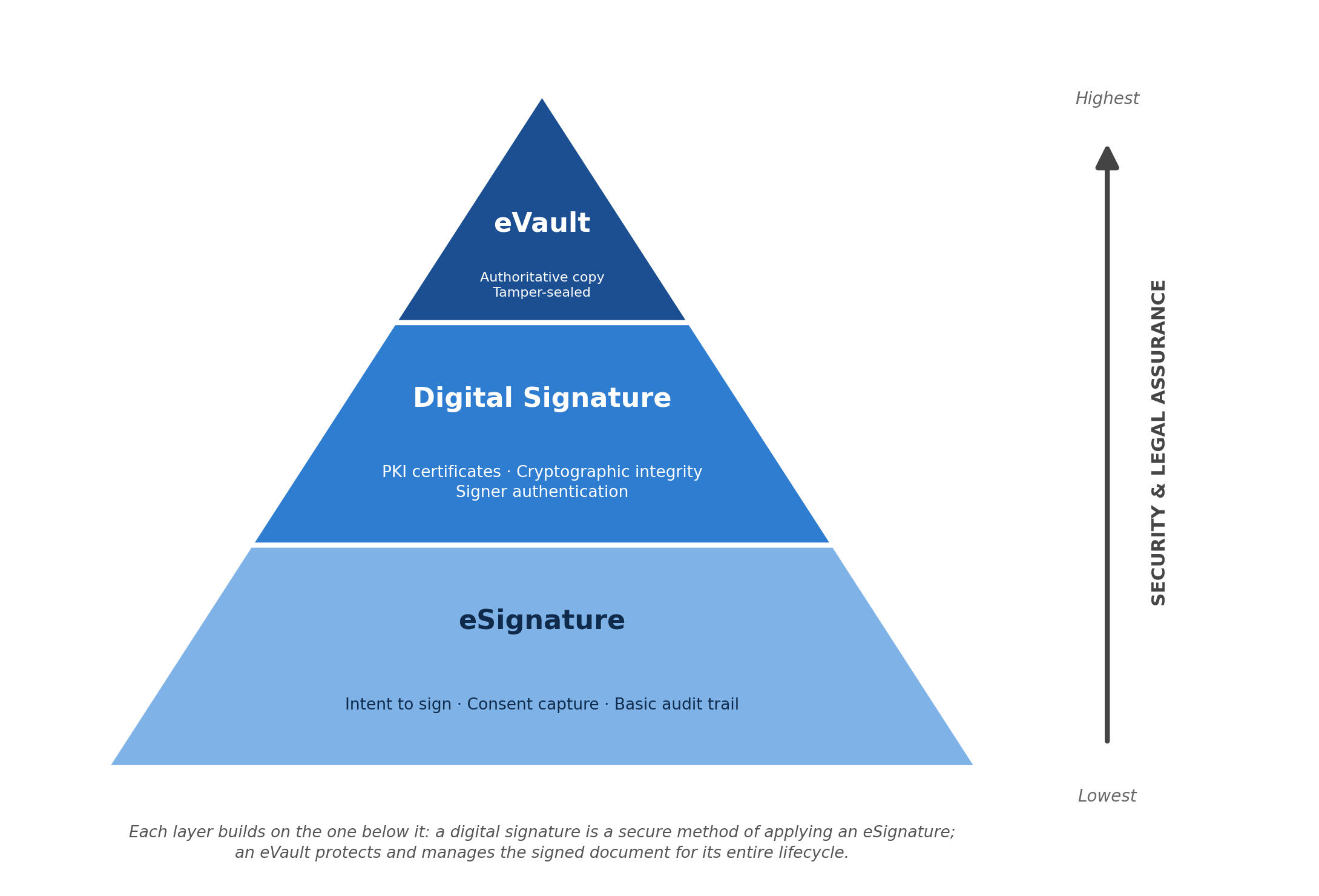
The pyramid below shows how the three methods stack in terms of security and legal assurance. eSignature forms the broad base used for everyday agreements; digital signatures add cryptographic identity and integrity; the eVault sits at the top, providing the highest level of assurance — certainty over the authoritative original and its chain of custody.
Side-by-Side Comparison
|
Aspect |
eSignature |
Digital Signature |
eVault |
|---|---|---|---|
|
What it is |
An electronic indication of intent to sign — a typed name, drawn signature, or click-to-sign action applied to a document. |
A cryptographic technology (PKI) that binds a signer's certificate to the document and seals its content. |
A secure electronic repository that stores and manages the single authoritative copy of a signed digital asset. |
|
Primary purpose |
Capture consent and intent quickly and conveniently. |
Prove signer identity and detect any change to the document after signing. |
Preserve the legal enforceability, negotiability, and transferability of the signed asset over its lifecycle. |
|
Security basis |
Audit trail (IP address, timestamp, email verification). |
Public Key Infrastructure: certificates issued by a Certificate Authority, hashing, and encryption. |
Tamper-sealing, encryption, granular access control, and an end-to-end digital chain of custody. |
|
Answers the question |
"Did this person agree to sign?" |
"Is this really the signer, and is the document unaltered?" |
"Who owns/controls the authoritative original, and can it be transferred or sold?" |
|
Typical use cases |
NDAs, sales quotes, HR forms, approvals, everyday agreements. |
Regulated contracts, financial and legal documents, government filings, high-value agreements. |
Digital loans, leases, mortgages, and other assets that are pledged, securitized, or sold on secondary markets. |
|
Stage of lifecycle |
At the moment of signing. |
At the moment of signing (with ongoing verifiability). |
After signing — for the entire post-execution life of the asset. |
|
Relative security level |
Baseline — legally valid, lighter evidence. |
Higher — cryptographic identity + integrity. |
Highest — certainty of the authoritative original + custody. |
How They Work Together
In a typical end-to-end digital transaction, the three methods are complementary steps in one flow:
-
Create & send: The document is generated (for example, merged from Salesforce data into a Word or PDF template) and sent for signature.
-
Sign: The signer applies an eSignature; for high-assurance transactions the platform secures it as a digital signature using PKI certificates.
-
Vault & manage: The executed document is deposited into the eVault, which designates it the authoritative copy and tracks every subsequent assignment or transfer.
Choosing between them is therefore not either/or: select the signing method based on the risk and regulatory profile of the transaction, and add eVault management when the signed document must remain a negotiable, transferable asset.
Quick decision guide (convert to a Note/Success panel via /note)
-
Everyday business agreement? eSignature is sufficient.
-
Regulated, high-value, or identity-critical? Use a digital signature.
-
Signed document will be pledged, securitized, or sold? Vault it in an eVault.
References
-
ESIGN Act / UETA (US) and eIDAS (EU) — governing frameworks for electronic and digital signatures.